
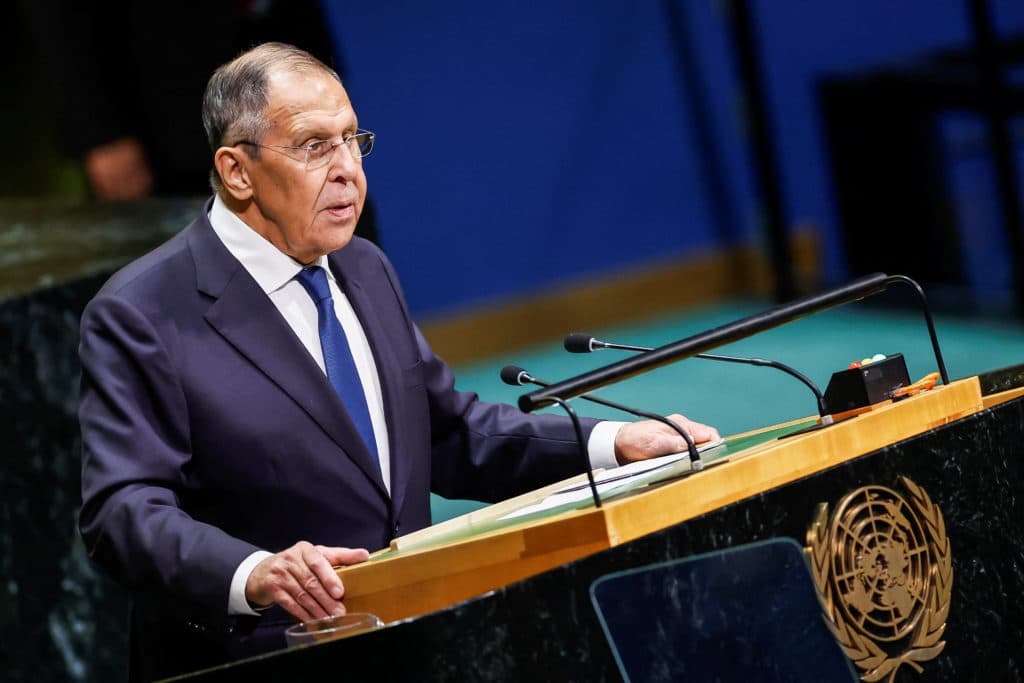
UNITED NATIONS — In a significant diplomatic move, German Foreign Minister Johann Wadephul and Russian Foreign Minister Sergey Lavrov held a rare face-to-face meeting on the sidelines of the United Nations General Assembly. This encounter marks the first direct tête-à-tête between the two nations' top diplomats since Russia’s full-scale invasion of Ukraine began in 2022.
A Heated Exchange at the U.N.
The meeting took place against a backdrop of rising tensions between the European Union and Russia. During the roughly 20-minute discussion, which ended with a handshake, Wadephul issued a stark warning to his Russian counterpart. According to a German delegation official, Wadephul called on Russia to abandon its “dangerous path of escalation” directed toward Germany, Europe, and the NATO alliance.
Ties between Berlin and Moscow have deteriorated sharply in recent weeks, particularly following an attempted drone attack at Leipzig airport last month, which Germany has attributed to Russian operatives. The incident triggered a series of tit-for-tat diplomatic and retaliatory responses.
Despite the harsh rhetoric, Wadephul signaled that Germany remains open to improving relations, but emphasized that such progress requires a genuine willingness from Russia’s leadership to end the war in Ukraine.
Lavrov’s Counterattack
Following the private meeting, Lavrov addressed the General Assembly, where he defended Russia’s military actions in Ukraine and launched a scathing critique of the West. While not naming President Donald Trump directly, Lavrov accused Western powers of trying to maintain their global privileges and impose rules on others, even as the geopolitical landscape shifts.
"A fairer, multipolar world order is emerging before our very eyes," Lavrov declared, highlighting Russia’s alignment with groups like BRICS as more forward-looking than Western institutions.
Lavrov also specifically rejected the idea of Germany or Japan gaining permanent seats on the U.N. Security Council, a move long supported by the United States. Later, in a news conference, Lavrov dismissed the substance of his earlier conversation with Wadephul, stating that “nothing new came from” the dialogue.
Global Repercussions and Casualties
The conflict continues to exact a heavy toll. Ukrainian President Volodymyr Zelenskyy used his address to the assembly to urge global partners to intensify pressure on Russia, noting that Moscow is escalating attacks daily. Recent data suggests over 500,000 Russian troops and more than 500,000 Ukrainian military personnel have been killed or wounded since the war began.
On the ground, the aerial war has intensified, with Russia deploying cruise missiles, glide bombs, and drones, while Ukraine targets Russian oil infrastructure. Civilian casualties remain high, with reports of deaths on both sides this past Saturday.
Beyond the battlefield, the war continues to disrupt global supply chains, impacting fuel, fertilizer, and grain shipments. Meanwhile, diplomatic efforts remain stalled; although the U.S. has passed new sanctions bills and President Trump has signed them into law, specific measures are yet to be fully enacted. Talks involving the U.S., Ukraine, and Russia have yielded no breakthroughs so far, with Kremlin spokesperson Dmitry Peskov confirming that while Putin and Trump discussed potential meetings, no concrete plans are in place.




Comments
No comments yet
Be the first to share your thoughts and start the conversation!