
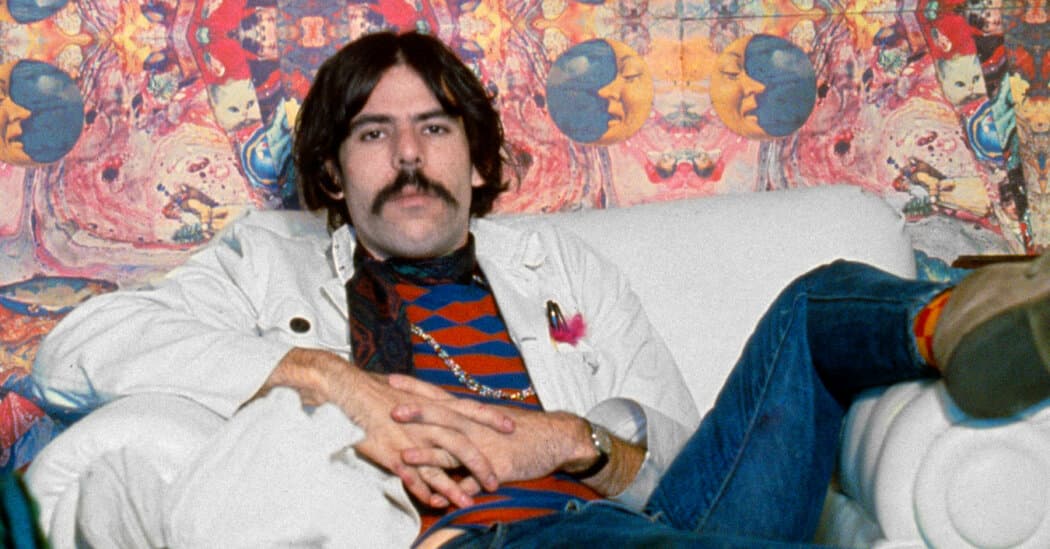
Peter Max, the visionary artist whose Day-Glo masterpieces defined the visual language of the 1960s counterculture, has died in Manhattan. He was 88.
Max’s death was confirmed by his son, Adam Max, noting that the artist had long suffered from dementia. A vegetarian and teetotaler who sought spiritual expansion through yoga rather than drugs, Max became one of the most commercially successful artists of his generation, selling millions of posters that captured the euphoric spirit of an era.
The Cosmic Aesthetic
Max’s work was characterized by brightly colored, simple graphic images that blended Art Nouveau, Op Art, and psychedelic motifs. His designs offered instant visual gratification, promoting themes of love, joy, and universal consciousness. He was famous for his “panopticon” images, which repeated visual elements to create a kaleidoscope effect reminiscent of Eastern mandalas.
One of his most iconic creations, the “Cosmic Runner,” depicted a young man in bell bottoms striding across the globe, surrounded by puffy clouds and birds. This image became an emblem of modern youth exploring inner and outer space. It was so influential that it appeared on the 10-cent stamp commissioned for Expo ’74, the conservation-themed World’s Fair in Spokane.
“My cosmic art subjects were always euphoric: Himalayan sages levitating under a shower of flowers... My inspiration came from the new youth movement in America and in return spoke to it.” — Peter Max, from his memoir "The Universe of Peter Max" (2013)
From Berlin to Brooklyn
Born Peter Max Finkelstein in Berlin in 1937, Max’s early life was shaped by global upheaval. As Nazism rose, his family fled to Shanghai, where he spent time with Buddhist monks. Later, they moved to Haifa, Israel, where he studied astronomy at the Technion before emigrating to New York in 1953.
Settling in Bensonhurst, Brooklyn, Max initially pursued realism and abstraction before finding his niche in commercial art. His breakthrough came in 1962 when he designed the LP sleeve for Meade Lux Lewis, winning a gold medal from the Society of Illustrators. After forming a successful design studio with Tom Daly, Max left in 1965 to focus on his own burgeoning style.
Commercial Dominance
Max revolutionized the intersection of fine art and commerce. In 1967, he partnered with Security Printing Company to produce Peter Max Posters, which sold millions of copies in bookstores and head shops. His influence extended far beyond prints:
- Licensing Empire: Through six businesses bearing his name, Max licensed his designs to over 70 companies, including General Electric (clocks), J.P. Stevens (linens), and Van Heusen (shirts).
- Public Art: In 1968, he designed transit posters for buses and subways in 10 major cities, famously stating, “I am bringing art to the people where the people are.”
- Cultural Impact: His poster for a 1967 Central Park gathering inadvertently coined the term “Be-In” after the words were misread as a noun.
His success was capped in 1969 when Life magazine featured him on its cover with the headline: “Peter Max: Portrait of the Artist as a Very Rich Man.”
 Peter Max, one of the most visible and successful artists of his generation, in 1967. Credit: Santi Visalli/Getty Images
 Mr. Max’s “Cosmic Runner.” Credit: Peter Max, via Park West Gallery
Mr. Max in 1973 in his studio. Through the half-dozen businesses bearing his name, he entered into licensing agreements with more than 70 companies. Credit: Dave Pickoff/Associated Press
Mr. Max in 2012. He designed the official poster for the World Cup in 1994. Credit: Simon Russell/Getty Images
The cover of Life magazine in September 1969. Credit: Life Magazine, via Park West Gallery




Comments
No comments yet
Be the first to share your thoughts and start the conversation!