NYC's first public bathroom plan counts 1,100 restrooms and projects just 46 more by 2030
The city's new 'A Right to Go' report says the law's goal of 2,120 public bathrooms will depend mostly on private businesses opening their restrooms, possibly for a stipend. Funded projects alone add only dozens.
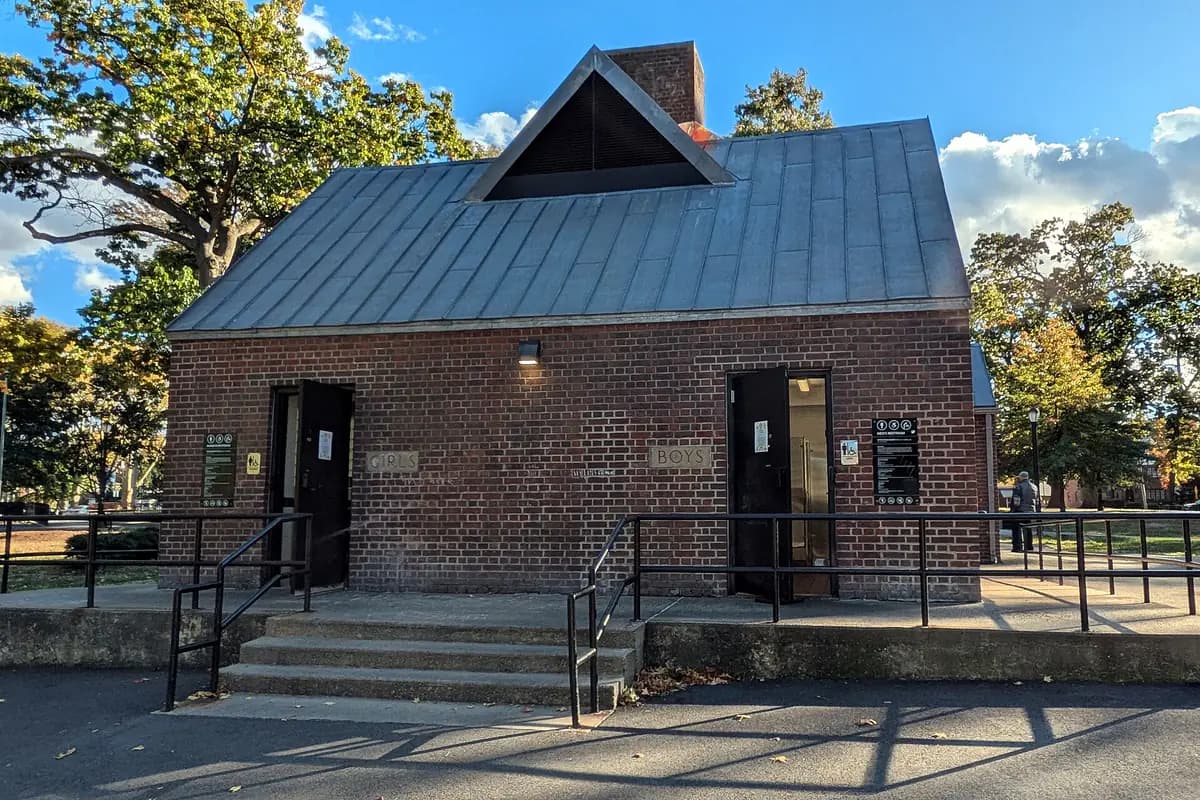
Photo: ComplexRational / Wikimedia Commons · CC BY-SA 4.0
- The Mayor's Office of Operations released 'A Right to Go,' the city's first public bathroom strategy under Local Law 58 of 2025, which sets a target of 2,120 public bathrooms.
- The city counts 1,100 publicly owned public bathrooms as of October 2026; Parks runs 796 of them and the three library systems 218.
- Projects already funded would add about 46 net new bathrooms by 2030 (about 1,150 total) and reach roughly 1,210 by 2042, far short of 2,120.
- The report says most growth must come from private partners and floats paying businesses a stipend, or waiving minor fines, to open restrooms to the public.
- Brooklyn has the fewest bathrooms per person (one per 8,900 residents); 27.5% of New Yorkers live within a five-minute walk of one.
New York City has released its first citywide plan for public bathrooms, and its own math shows how far the city is from the goal the City Council set. The report, A Right to Go, posted by the Mayor's Office of Operations and dated October 2026, counts 1,100 publicly owned public bathrooms across the five boroughs. Local Law 58 of 2025 sets a target of at least 2,120, at least half publicly owned.
The city technically clears that publicly owned floor of 1,060. But the projects already funded and underway would add only about 46 net new bathrooms by 2030, for roughly 1,150 in total, and about 20 more every four years after that, reaching about 1,210 by 2042, the report says. Those benchmarks reflect current funding only and are described as "a floor, not a ceiling."
Where the bathrooms are
- Parks: 796 bathrooms, about three-quarters of the network. Another 71 Parks bathrooms are closed; 16 of those have funded or active capital projects. The average Parks bathroom building is about 67 years old.
- Libraries: 218 (NYPL 91, Queens Public Library 65, Brooklyn Public Library 62).
- Modular pilot: 17 Throne Labs units, open 7 a.m. to 10 p.m., at about $222,000 each for the year ($270,000 on Staten Island), a $4 million pilot. Money for a second year has not been secured.
- Automatic public toilets: 8 DOT/JCDecaux units, including Madison Square Park, Fordham Plaza and Corona Plaza. The franchise allows up to 40; a new one at Park Circle in Brooklyn is expected in 2027.
By borough, the report counts 296 public bathrooms in Brooklyn (one per 8,900 residents), 287 in Queens (8,100), 253 in Manhattan (6,400), 192 in the Bronx (7,300) and 72 on Staten Island (6,900). Nearly everyone (98.5%) lives within a 20-minute walk of one, but only 27.5% live within five minutes. The biggest gaps are in residential central Staten Island and the far Rockaways, and access along busy streets is weaker in outer Brooklyn, outer Queens and all of Staten Island.
The plan: pay businesses to open their restrooms
The report says "a substantial majority" of growth toward 2,120 is expected to come from private-sector partnerships, because Parks can start only about five new bathroom projects a year with current funding. It lays out two possible incentives for businesses that open restrooms without requiring a purchase: waiving minor administrative fines, or a direct stipend, modeled on London's community toilet schemes, with higher tiers for longer hours and accessible, gender-neutral facilities. The city will consider piloting this in a few high-need corridors first.
Other ideas include adding about 70 MTA bathrooms (mostly behind fare gates) to the network, planning restrooms into IBX stations, opening bathrooms in city office buildings once they meet ADA rules, and designing bathrooms into new publicly funded buildings.
What's next
The report was due Sept. 1. In August, Deputy Mayor for Operations Julia Kerson told the Council it would be late and that City Hall hoped to file by Nov. 1, The City Reporter reported. The deputy mayor's office will now produce an action plan by the end of 2027 with priorities, lead agencies and milestones; the next progress report is due in 2030.
The plan arrives days after records showed dozens of Parks bathrooms sitting closed, some for more than a decade.
- NYC Mayor's Office of OperationsA Right to Go: New York City's Citywide Public Bathroom Strategy (October 2026)
- NYC Mayor's Office of OperationsReports
- intro.nyc (NYC Council legislation)Local Law 58 of 2025
- The City ReporterNYC Wants 2,100 Public Restrooms, but City Hall's Bathroom Strategy Is Backed Up
Every story links to the reporting and records it’s based on. Our editors write each piece from public reporting and official data, and check it against those sources before it’s published.
Comments
0NSynced with CommunityIn CommunityYour comment is also posted to Community with this story attached, so neighbors can find it and reply there too.
No comments yet
Start the conversation — your comment shows up here and in Community for neighbors nearby.