Central Park's Seneca Village signs are returning to their original spots by mid-December
The outdoor exhibit marking the 19th-century community of Black landowners was moved for the West 85th Street Playground rebuild. Here is what's changing.
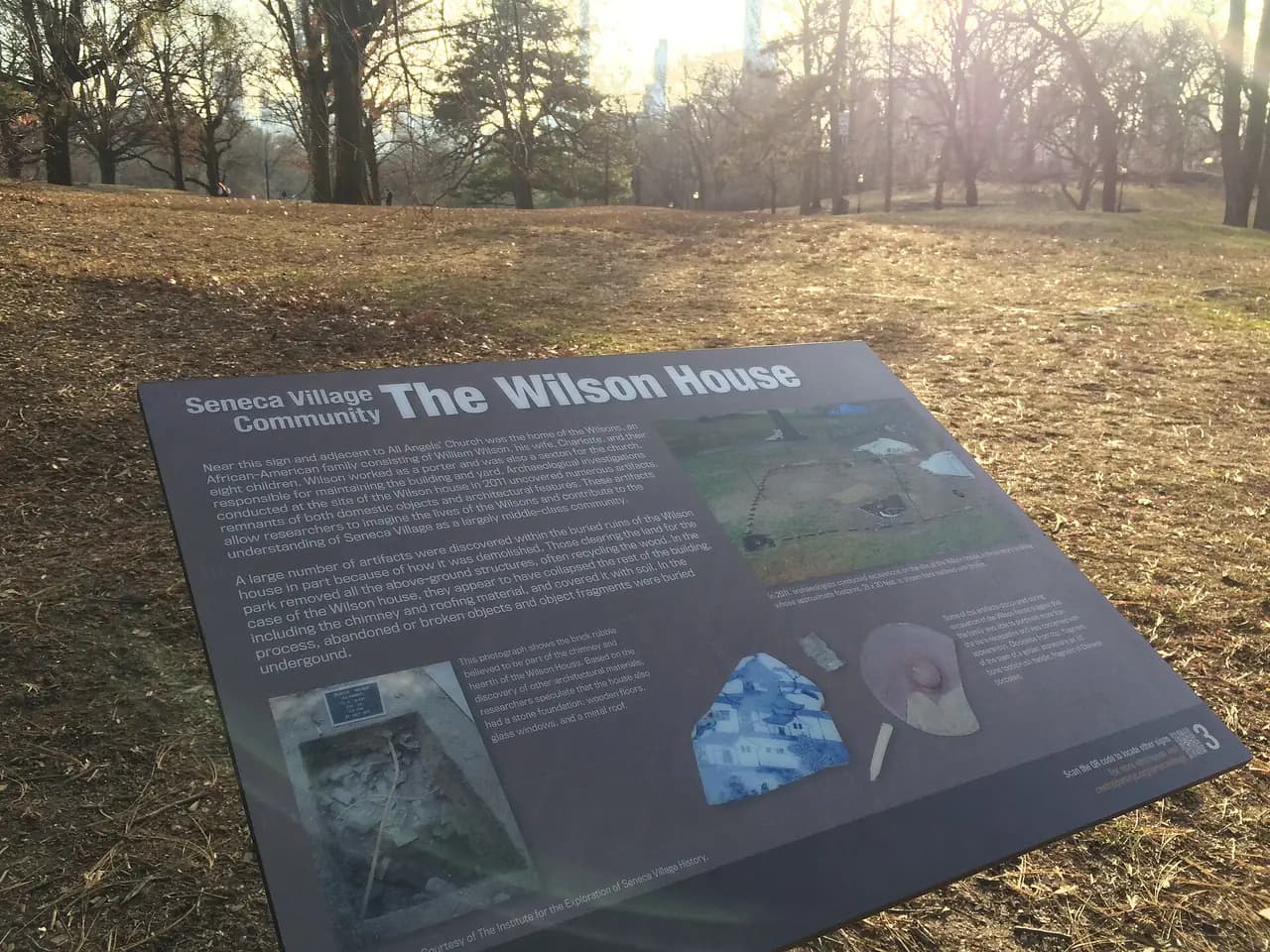
Photo: Allison Meier / Wikimedia Commons · CC BY-SA 2.0 (https://creativecommons.org/licenses/by-sa/2.0/)
- The Central Park Conservancy says the Seneca Village exhibition signs, between West 82nd and 89th streets, will be back at their original locations by mid-December.
- The signs were moved temporarily for the reconstruction of the West 85th Street Playground, which sits inside the old village site.
- The rebuild adds new play equipment and a lower fence, and redesigns the entrance for Seneca Village tours and gatherings; completion is targeted for fall 2026.
- Seneca Village (1825–1857) was one of Manhattan's first notable communities of Black property owners, with about 225 residents by 1855.
- The city took the land by eminent domain for Central Park and forced out all residents by the end of 1857.
The outdoor signs that mark where Seneca Village once stood in Central Park are going back where they belong. The Central Park Conservancy says on its park alerts page that the exhibition signs, on the West Side between 82nd and 89th streets, are being relocated and will be back at their original locations by mid-December.
Why they moved
The signs were moved temporarily for the reconstruction of the nearby West 85th Street Playground, according to CentralPark.com. The playground, formerly the Abraham and Joseph Spector Playground, is one of the park's largest. It was built in the 1930s and last renovated in 1991, and it sits inside the old Seneca Village site, near what was once a center of village life with churches, homes and streets, the Conservancy says.
The rebuild includes new swings, climbers and water play, a lower four-foot fence, more room for the mature trees and an accessible path to the West 84th Street playground. The entrance is also being redesigned to make room for Seneca Village tours and gatherings; the Conservancy's own tours already start near that spot. The Conservancy has targeted completion for fall 2026, and Hoodline reported this month that the playground had been expected to reopen around Thanksgiving.
What Seneca Village was
- From 1825 to 1857, the land between roughly West 82nd and 89th streets, from Seventh to Eighth avenues, was home to Seneca Village, one of Manhattan's first notable communities of Black property owners.
- By 1855 it had about 225 residents, roughly two-thirds African American and one-third Irish immigrants, plus a few German residents, according to the Conservancy.
- The city took the land by eminent domain to build Central Park, and by the end of 1857 every resident had been forced out.
- The outdoor exhibit marks sites like the village's churches and individual homes, including the Wilson House.
Visiting
The exhibit is near the West 85th Street entrance at Central Park West. The Conservancy also lists a Seneca Village walking tour in its winter programming.


- Central Park ConservancyAlerts: Seneca Village Landscape
- Central Park ConservancyWest 85th Street Playground Reconstruction
- Central Park ConservancyBefore Central Park: The Story of Seneca Village
- CentralPark.comSeneca Village
- HoodlineRudin Playground Near West 96th Street Set for Full Rebuild, Swings and Sandbox Staying
Every story links to the reporting and records it’s based on. Our editors write each piece from public reporting and official data, and check it against those sources before it’s published.
Comments
0NSynced with CommunityIn CommunityYour comment is also posted to Community with this story attached, so neighbors can find it and reply there too.
No comments yet
Start the conversation — your comment shows up here and in Community for neighbors nearby.