Modern subway fare gates are coming to 20 more stations. Here's the list.
After a pilot the MTA says cut fare evasion by 35%, every fare array will be replaced at stations including 14 St-Union Sq, 161 St-Yankee Stadium and Flushing-Main St. Prep work starts this month.
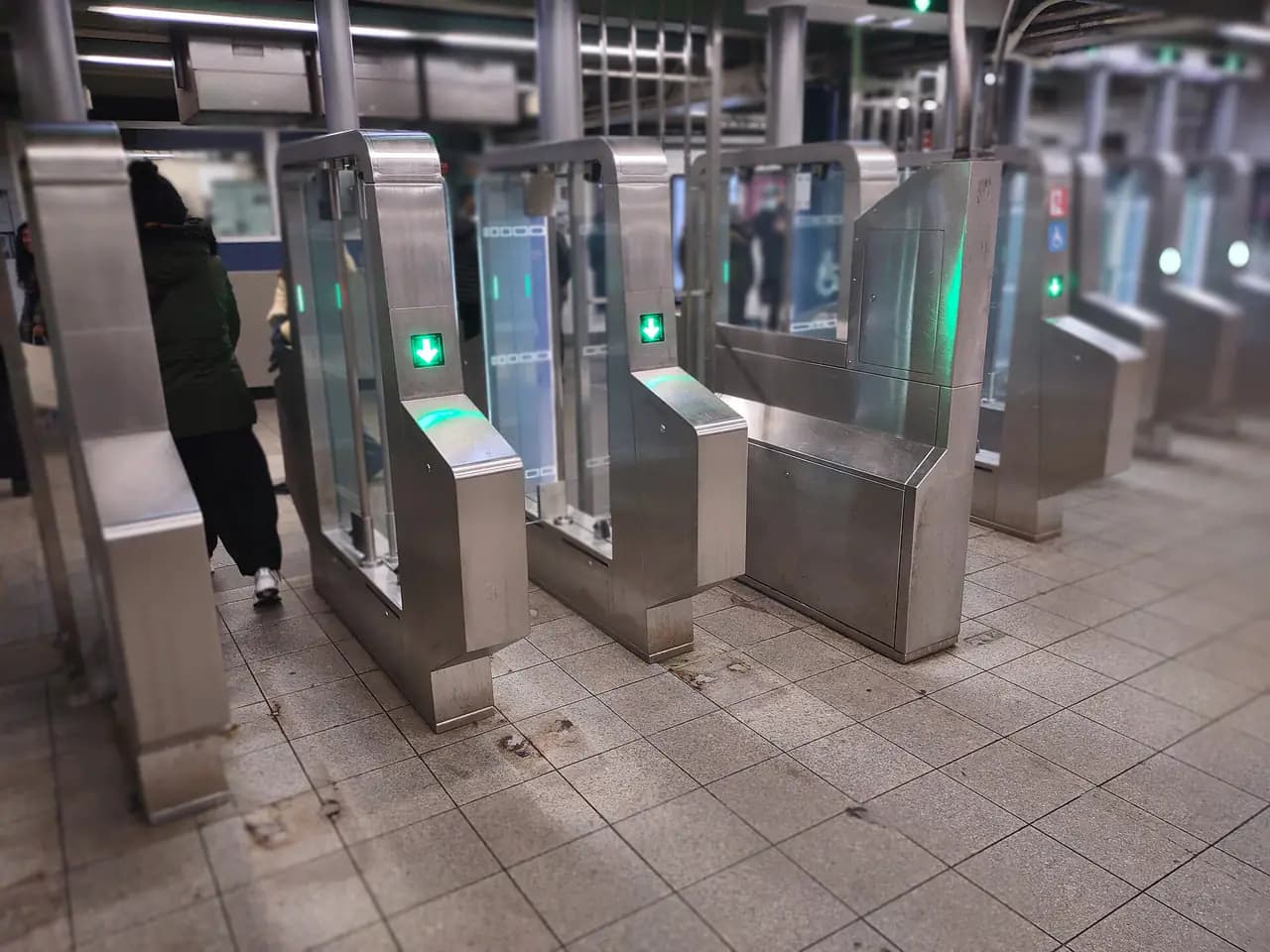
Photo: Jim.henderson / Wikimedia Commons · CC BY-SA 4.0
- The MTA will put modern fare gates at every entrance of 20 more subway stations: six in Brooklyn, four in the Bronx, six in Manhattan and four in Queens, Gov. Kathy Hochul announced Oct. 7.
- Early station preparation is expected to start in October, with new gates going in by the end of 2026, according to the governor's office.
- At the 20 pilot stations, fare evasion fell an average of 35%, and by 72% at Hoyt St (2/3) and Nostrand Av (A/C), the MTA said.
- Three vendors, Cubic, STraffic and Conduent, qualified to bid. The pilot replaced one fare array per station; the next phase replaces all of them, amNewYork reported.
- Thirty more stations are planned next year, for 70 in total, as part of a $1.1 billion plan covering 150 stations that serve nearly three quarters of daily riders.
Sliding-door fare gates are coming to 20 more subway stations, from Coney Island-Stillwell Av to 161 St-Yankee Stadium, after a pilot that the MTA says cut fare evasion by an average of 35%.
Gov. Kathy Hochul announced the next stations on Oct. 7. Early preparation work is expected to start this month, and new gates are expected to begin going in by the end of 2026, according to the governor's office.
The next 20 stations
Brooklyn
- 36 St (D, N, R)
- Bedford Av (L)
- Coney Island-Stillwell Av (D, F, N, Q)
- Hoyt-Schermerhorn (A, C, G)
- Myrtle Av (J, M, Z)
- Newkirk Plaza (B, Q)
Bronx
- 3 Av-149 St (2, 5)
- 161 St-Yankee Stadium (4, B, D)
- Fordham Rd (B, D)
- Parkchester (6)
Manhattan
- 14 St-Union Sq (4, 5, 6, L, N, Q, R, W)
- 72 St (1, 2, 3)
- 86 St (4, 5, 6)
- 125 St (4, 5, 6)
- Chambers St (1, 2, 3)
- Spring St (C, E)
Queens
- Astoria Blvd (N, W)
- Flushing-Main St (7)
- Forest Hills-71 Av (E, F, M, R)
- Sutphin Blvd/Archer Av-JFK Airport (E, J, Z)
What changes for riders
The new gates use long glass doors and sensors in place of the three-arm turnstiles the MTA began installing in the early 1990s. They are wider, so riders using wheelchairs, pushing strollers or carrying luggage can pass through without the emergency exit gate, which the governor's office says has become a "superhighway" for fare evasion.
In the pilot, the MTA swapped out a single fare array at each station. At the next 20 stations, every array will be replaced, MTA Construction and Development President Jamie Torres-Springer said, according to amNewYork.
What the pilot found
Fare evasion dropped an average of 35% at the 20 pilot stations, with the biggest declines at Hoyt St (2, 3) and Nostrand Av (A, C), both down 72%, and 3 Av-138 St (6), down 65%, according to the governor's office. Riders have made roughly 29 million entries and 34 million exits through the new gates since the pilot began.
Three companies, Cubic, STraffic and Conduent, tested gates at no cost to the MTA and have qualified to bid on the next phase, with bids due this month. The MTA has not said which design worked best; MTA Chair Janno Lieber said the companies tested at different stations, so a direct comparison isn't possible yet, amNewYork reported.
The bigger plan
Fare evasion costs the MTA an estimated $400 million a year, Gothamist reported, and Hochul said the gates could save nearly $100 million a year. The MTA plans 30 more stations in 2027, for 70 including the pilot sites. The full program, funded with $1.1 billion in the MTA's 2025-2029 capital plan, covers 150 stations that serve nearly three quarters of daily subway riders, according to the governor's office.
- Office of Gov. Kathy HochulGovernor Hochul Announces New Subway Gate Pilot Reduced Fare Evasion by 35%, Unveils Next 20 Stations to Receive Modern Fare Gates
- GothamistMTA moves ahead with $1.1B plan to put modern fare gates at 150 subway stations
- amNewYorkFare evasion: Hochul, MTA leaders say stations testing modern fare gate models see 35% drop in the costly crime
Every story links to the reporting and records it’s based on. Our editors write each piece from public reporting and official data, and check it against those sources before it’s published.
Comments
0NSynced with CommunityIn CommunityYour comment is also posted to Community with this story attached, so neighbors can find it and reply there too.
No comments yet
Start the conversation — your comment shows up here and in Community for neighbors nearby.